Mattress Education
What Makes a Mattress Compatible with an Adjustable Bed?
An adjustable base can turn a flat bed into a more versatile place to sleep, read, or unwind. But a mattress must do more than match its dimensions: it needs to flex with the moving platform, remain properly supported, and recover its shape when the bed returns to level.
Understanding mattress construction, flexibility, thickness, weight, and manufacturer guidance can help you build a sleep setup that moves smoothly without putting unnecessary strain on either component.
Compatibility is about movement, not just fit
An adjustable bed base changes the angle of the sleeping surface, typically lifting at the head, the foot, or both. As the base moves, the mattress must bend at the same points while staying supported across the platform. A mattress that fits the base in length and width may still be unsuitable if its construction is too rigid, too heavy, or not approved for repeated flexing.
Think of the mattress and base as a pair of components with different jobs. The base provides motion and a supporting platform; the mattress supplies the comfort layer and sleep surface. For the arrangement to work, the mattress needs to follow the base’s movement without buckling, sliding, or placing excessive tension on its materials.
Compatibility is not a universal promise attached to a material label. Foam, latex, hybrid, and other mattresses can differ substantially in their layer arrangement, internal reinforcements, covers, and overall flexibility. The most dependable starting point is the mattress maker’s written guidance for the specific model, followed by the adjustable-base manufacturer’s requirements.
Start with the manufacturer’s guidance
Before placing a mattress on an adjustable base, check the model’s product information, owner’s manual, or warranty terms. Look for a clear statement that the mattress is compatible with an adjustable base, along with any conditions attached to that approval. Some guidance may apply only to particular sizes, base styles, or positions; some may specify a minimum or maximum thickness or a weight limit.
Check both sides of the pairing. A mattress might be designed to flex, while a particular base may have limits on the type of mattress it can support. Conversely, a base may accommodate a broad range of mattress types, but the mattress maker may exclude adjustable use from the warranty. Written confirmation helps prevent assumptions based on general material descriptions.
If the information is unclear, ask the manufacturer or retailer about the exact mattress model, size, base model, and intended use. Ask whether the mattress is approved for head-and-foot articulation, whether there are limits on how frequently it can be adjusted, and whether added layers such as toppers or pads change the recommendation. Keep any response with your purchase records.
- Confirm compatibility for the specific mattress model, not merely the brand or material category.
- Review the adjustable base’s manual for platform, weight, and operating requirements.
- Check warranty language for exclusions related to bending, sagging, or use on a powered base.
- Ask whether accessories or a particularly thick comfort layer affect the approved setup.
Why flexibility and construction matter
When an adjustable base raises, the mattress bends through a changing curve. A mattress built to accommodate that motion should follow the platform without resisting it so strongly that it lifts away, folds sharply, or strains at the bend points. It should also settle back into its usual shape when the base is flat.
How easily a mattress flexes depends on its full construction. The comfort layers, support core, internal zoning, perimeter reinforcement, adhesives, quilting, and cover can all contribute to how it responds. A soft upper layer does not necessarily mean the entire mattress is flexible: a firm, rigid core beneath it may limit movement. The reverse is also true. A mattress that feels firm in use can still be designed to bend smoothly when supported by a compatible base.
Construction details are more useful than broad claims such as “all foam” or “natural.” Foam mattresses vary in density, firmness, and layer configuration. Latex mattresses vary in thickness, firmness, and how their layers are assembled. Innerspring and hybrid designs can differ according to coil geometry, unit construction, perimeter support, and the materials layered above the coils. None of these labels alone guarantees compatibility.
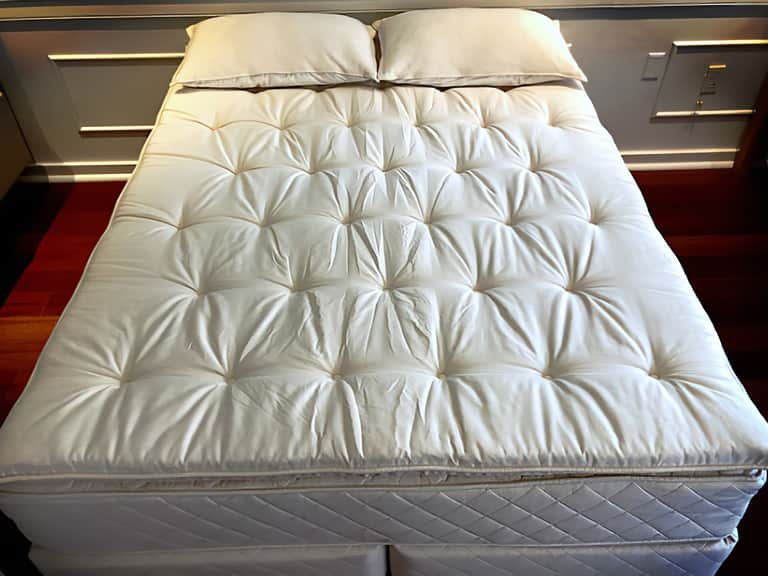
For a model specifically identified as adjustable-base compatible, a useful example is the Naturally Organic Hudson Luxe Latex Mattress. Its product details list adjustable-base compatibility. That model-specific information is more meaningful than assuming every latex mattress will behave the same way; the relevant guidance should still be checked against the particular base and setup.
Material response: useful clues, not a verdict
Foam
Foam can often flex with an adjustable platform, but the word covers many different constructions. Layer thickness, firmness, density, and the design of the core all influence how a mattress bends. A foam model with several thick, highly structured layers may move differently from a simpler, more pliable design. Consult the manufacturer rather than treating foam as automatic approval.
Latex
Latex mattresses may use one or more layers, with the feel and flexibility shaped by how those layers are arranged and enclosed. A multi-layer design may articulate differently from a single dense block, and a substantial topper can affect the overall bend. Look for explicit adjustable-base guidance for the finished mattress, including any attached or integrated comfort layers.
Innerspring and hybrid designs
Innerspring and hybrid mattresses incorporate coil systems, which can respond differently to bending depending on their construction and surrounding materials. The type of coil, how it is connected or arranged, and the presence of reinforced edges can all matter. Some models are designed and tested for adjustable bases; others may have restrictions. Do not assume that a coil mattress is incompatible—or compatible—without checking the model specifications.
Older or unusually rigid mattresses
A mattress that has developed deep impressions, weakened edges, or an uneven shape may not move as intended, even if its original design allowed flexing. Age and condition are relevant: an adjustable base can reveal weaknesses that were less noticeable on a flat foundation. If the mattress is already distorted or damaged, get guidance before adding powered movement.
Thickness, weight, and the shape of the setup
Thickness is worth checking because a taller mattress may have a different internal structure and can place different demands on the base as it bends. Yet there is no single thickness rule that applies to every adjustable bed. One base may accept a wide range, while another may set a specific limit. Follow the published range for the equipment you own.
Weight matters, too. The adjustable base must support the combined load it is designed for, including the mattress, sleepers, bedding, and any accessories. A heavier mattress can affect how the motorized platform performs, particularly if the total load approaches the base’s stated capacity. Check whether the manufacturer expresses capacity as a combined limit and whether the limit varies by size or configuration.
Also consider how far the mattress extends beyond the base, how it sits on the platform, and whether its surface remains centered as the base moves. A mattress that shifts or overhangs can interfere with stable support. Use the bed’s intended dimensions and attachment method, and avoid modifications that the base maker has not approved.
- Compare mattress thickness with the base’s stated mattress range.
- Check the base’s load limit and account for the complete sleep setup.
- Confirm that mattress size matches the platform and any split-base arrangement.
- Ask whether a topper, protector, or other layer affects movement or fit.
How often you adjust the bed can shape the choice
Some sleepers change the bed position regularly; others raise it only occasionally. Frequent movement makes the mattress’s ability to flex and return to its resting shape especially relevant. Repeated bending can place ongoing demands on materials and seams, so a product’s guidance for adjustable use should be considered alongside its construction and warranty.
Think about the positions you expect to use. Raising only the head may create a different bend pattern from lifting both the head and foot. A split adjustable setup, where each side moves independently, may require separate mattresses sized for the corresponding platforms. Confirm that the mattress and base are intended to work in that configuration, particularly if you plan to use a shared top layer.
There is no need to operate the bed at extreme angles simply to test compatibility. Follow the base instructions and use ordinary, supported positions. If the mattress visibly buckles, lifts away, slides, or makes unusual noises as the base moves, return it to level and investigate the fit rather than forcing further adjustment.
A practical compatibility check before you buy
A little preparation can make the decision more straightforward. Gather the exact model names and measurements for both components, then compare the product guidance rather than relying on a general description from a search result or sales conversation.
- Identify the base. Record its model, size, operating style, and stated weight capacity.
- Identify the mattress. Note its model, size, thickness, weight, and construction where available.
- Find explicit approval. Look for a manufacturer statement about adjustable-base use for that mattress model.
- Compare restrictions. Check the mattress and base manuals for limits on thickness, weight, position, or configuration.
- Account for accessories. Ask whether a topper, pad, protector, or headboard connection changes the setup requirements.
- Check warranty terms. Make sure the intended use does not conflict with either product’s coverage.
- Keep documentation. Save manuals, product specifications, and written answers for future reference.
If you already own both pieces, begin with the manuals before assembling or operating the setup. Follow the base manufacturer’s installation instructions, and make sure the mattress is positioned as directed. A careful setup protects more than comfort: it helps keep the mattress and moving platform working as their designers intended.
What to observe when the bed moves
Once compatibility is confirmed and the base is assembled correctly, a slow, controlled adjustment can help you notice whether the mattress follows the platform. You are looking for smooth movement and stable support—not proof that the mattress can tolerate any angle or operating pattern.
Pay attention to whether the mattress remains in position, whether the surface bends along the intended hinge points, and whether its edges stay supported. When the bed returns to level, the mattress should settle rather than remain visibly folded or distorted. Normal differences in feel between flat and elevated positions are expected; persistent buckling, sliding, separation from the platform, or unusual creaking warrants a pause and a review of the instructions.
Noise can come from the base, frame, floor, or mattress components, so it is not automatically evidence of a mattress problem. Still, a new or pronounced sound during movement should not be ignored. Check that the base is assembled and placed correctly, then contact the appropriate manufacturer if the sound persists or the mattress does not move smoothly.
Care and warranty considerations
Use the mattress in the positions permitted by its manufacturer, and avoid bending, folding, or storing it in a way that is not specified in its care instructions. An adjustable base is designed to create movement through its own mechanism; manually forcing a mattress around corners or compressing it for storage is a different kind of stress.
Care instructions remain relevant after the mattress is paired with a base. Rotate the mattress only if and as directed, since some designs are one-sided or have a designated head and foot. If rotation is recommended, check how to do it safely with the base and any headboard or footboard attachments. Keep bedding and accessories from obstructing the base’s moving parts, and follow the base manual for cleaning and maintenance.
Warranty coverage usually depends on the product’s own written terms. Compatibility approval does not necessarily mean every condition is covered indefinitely, and a base warranty may have its own operating and load requirements. Save proof of purchase, note any model-specific restrictions, and report a concern promptly rather than continuing to operate a setup that appears unstable.
Common assumptions to set aside
“If it fits the frame, it will work.”
Dimensions are only one part of mattress compatibility. A correctly sized mattress still needs the right flexibility, support, and manufacturer approval to move with the base.
“Every foam mattress is adjustable-bed friendly.”
Foam can be flexible, but mattress construction varies widely. A model’s layers, thickness, core, and cover matter, so check the specific product guidance.
“A thicker mattress is always unsuitable.”
Thickness alone does not settle the question. The relevant limit depends on the base and the mattress. Use the published specifications for both rather than relying on a universal rule.
“A mattress that bends once can be adjusted indefinitely.”
One movement does not establish long-term suitability. Repeated flexing, load, age, and maintenance all matter. Choose a model approved for the intended use and operate it within its guidance.
The essentials, at a glance
A compatible mattress is not simply one that can be lifted at the head or foot. It is one whose construction is intended to flex with the base, whose size and weight are within the system’s limits, and whose use aligns with both manufacturers’ care and warranty guidance.
Prioritize explicit model-specific approval. Then compare flexibility, mattress thickness, total load, platform configuration, and how often you expect to adjust the bed. Finally, follow installation and care instructions, and pause if the mattress shifts, buckles, or behaves unexpectedly.
With those details in view, an adjustable bed can be planned as a considered sleep setup rather than a simple frame-and-mattress pairing. The goal is movement that feels seamless because every part of the system is suited to the work it has been asked to do.